Journal
Razor bumps and irritation: what a barber can and cannot do
A barber can change how you are shaved, or not shave you at all. A barber cannot treat your skin — and should say when it is time to see a doctor.
A barber can change exactly two things about how you are shaved: the technique, or whether it happens at all. What a barber cannot do is treat skin that is already reacting — that is a doctor's work, not a barbershop's, and a good barber says so plainly rather than guessing at it.
What actually happens
A little redness right after a close shave or a tight line-up is ordinary: the skin nearest a fresh edge is briefly more sensitive, and it usually settles within a day. Small bumps sometimes follow a shave in curlier hair, where a cut hair can curl back and meet the skin again as it comes back in, especially at the neckline and along the jaw.
None of that is a reason to stop having your hair cut or your beard lined up. It is a reason to change how the closest parts are shaved, which is entirely within a barber's control.
Where it happens most
A line-up is booked every one to two weeks and a beard trim every ten to fourteen days — both far more often than a full cut. That means the same narrow strip of skin along the hairline or the jaw gets a fresh razor edge again and again, every couple of weeks, all year. A classic cut somebody wears for a month does not put nearly the same repeat traffic on one small patch of skin.
That is exactly why a small change in technique on those two services is worth more than it would be anywhere else on the menu: it is not a one-time adjustment, it is one that gets repeated on the same schedule as the visit itself.
What changes with technique
Every straight-razor service uses a new single-use blade, and the used one goes straight into a sharps container. Our practice. A duller, reused blade tugs at hair instead of cutting it cleanly, and tugging is most of what turns an ordinary shave into an irritated one.
A barber can also finish the closest lines — the neckline, the edge of a beard, the hairline on a fade — with a trimmer instead of a razor, leave slightly more length at the edge, or use fewer passes over the same patch of skin. None of that changes the price of the cut; it changes how it is done, and it is worth asking for by name before the barber starts.
Heat and lather do some of the work first
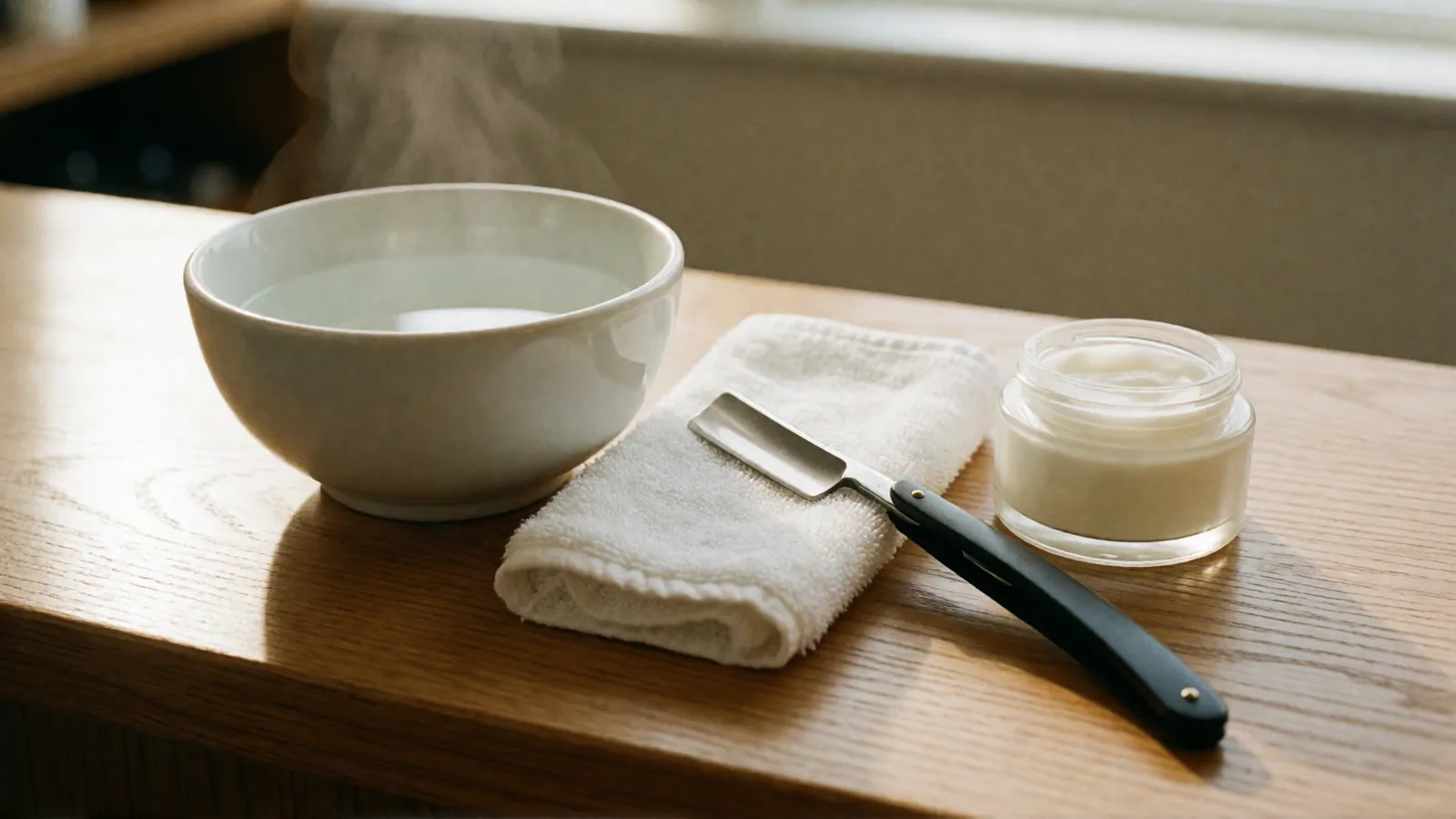
A hot towel shave is booked every two to four weeks, and the hot towel at the start of it is not just for comfort: warm, damp heat softens hair before a blade ever reaches it, so the razor needs less force to cut cleanly. Less force against the skin is, again, most of what separates an ordinary shave from an irritated one.
Shaving lather is worked in warm, by hand. There is no shared shaving brush and no mug. Our practice. Lather worked in with fingers reaches the skin more evenly than lather slapped on with a brush, and there is no shared brush here to begin with — a detail that is about keeping tools clean between clients more than about irritation, but it happens to help both.
What this shop will not shave over
No razor goes over broken, sore or irritated skin. The barber will say so, and finish with a trimmer instead. Our practice.
The same rule is repeated on every page that sells a razor service, on purpose, rather than stated once and assumed to carry over. On a hot towel shave: A razor is never taken over broken, sore or irritated skin, and the barber will say so rather than shave around it.
On a beard's own lines: The razor edge is never taken over broken, sore or irritated skin; the barber will finish with a trimmer instead. And on a skin fade's finish: The fade is finished with a razor line, so a skin fade is never done over broken or irritated skin.
When it is time to see a doctor, not a barber
A little redness that fades within a day or two is common and not a reason to see anyone. A rash that spreads rather than fades, real pain, swelling, or any sign of infection is different — it is not something to keep shaving over, and it is not something a barber is the right person to look at.
The same goes for the scalp. Nobody here treats hair loss or a scalp condition. If your scalp is sore, flaking or has a rash, the barber will skip the razor and suggest you see a doctor.
Curlier hair and the closest edges
Curlier hair is more likely to curl back into the skin as it grows out, which is part of why bumps show up more often at a curly hairline or a curly beard's edge than on straight hair cut to the same closeness. It is a shape-of-the-hair issue, not a hygiene one, and it does not mean a closer style is off the table — only that saying so before the razor starts is worth doing every time, not just once.
What to say before the barber starts
If the skin along your neckline or jaw is often irritated after a shave or a close line-up, say so before the cape goes on, not after. “Leave it a little looser at the neck,” “finish that edge with a trimmer instead of a razor,” and “skip the razor there this time” are all ordinary requests, and a barber would rather hear them first than find out partway through.
None of that is a one-time conversation, either. Since a line-up and a beard trim both come around every couple of weeks, whatever you ask for once is worth repeating the next time and the time after — a barber remembers a regular's preferences, but a new request said out loud every visit is more reliable than hoping it was written down somewhere.
Where to go next
- Hot towel shaves — the full straight-razor service.
- Beard trims and sculpting — where a line-up is usually asked for.
Book a chair, or just walk in
Book a time with the barber you want, or with whoever is free first — or just walk in. The online calendar always keeps a chair back for walk-ins, and nothing is paid online.