Being honest about it
How these pictures were made
Every photograph on this site was generated from a written description. None shows a face, a child or a real place.
Generated, not photographed
This shop is invented, so there was nobody in a chair to photograph and no real barbershop to point a camera at. What a picture can still show honestly is a way of working — where a barber's hands sit on the clippers, how a hot towel is folded, what a tile floor in a Queens shop looks like — and that is what these pictures are for.
About the photographs. Every photograph on this site was generated, and every picture with any part of a person in it says so on the picture. Nobody in them is a client, and no face appears anywhere: a barbershop's pictures here are the chair, the tools and the back of a head.
The eleven rules the descriptions were written under
Each picture began as a paragraph of written description, not an instruction a person could follow with judgment. So each rule below is a decision about what the description leaves out, rather than a request the result was checked against afterward.
No face
A client is photographed from directly behind, or lying back under a hot towel that hides the eyes, nose and mouth. A barber appears as hands and arms, never a head.
No mirror in a picture with a person
A barbershop's mirror is where the face would be. Mirrors appear only in empty rooms.
No child
The kids' pages show the booster seat and the small cape, with nobody in them.
No maker's side of a tool
A clipper carries its maker's name on the housing, so it is shown blade-end first. No clipper guard appears at all: guards carry moulded numbers.
Nothing with a label
Every tin, bottle and jar is plain. No product in any picture can be read.
Bare walls
No price board, no framed license, no poster, no clock, no screen, no neon.
No window with a name on it
A shop window carries its name backward, so no picture looks out through the storefront, and a window that does show is a plain pane with nothing written on it or beyond it.
No maker's plate on a chair
The footrest is where a chair's maker puts a plate, so it is out of the picture or in shadow.
Bare hands
No ring, no watch, no tattoo: a tattoo is where lettering hides.
A Queens storefront, named by its parts
A pressed-tin ceiling, a black-and-white hexagonal tile floor, white subway tile and oxblood leather chairs — because the model's default room is not American.
Every head of hair different
Straight, wavy, curly, coily, gray and shaved smooth, because Woodside's is.
A cut, not a client
A photograph of a fade on a barbershop's own website reads as a fade this shop cut, so every haircut shown from behind carries two sentences under it: what the cut is, and then the same second sentence under every one of them: "Demonstration image, generated for this sample site."
Everywhere else, a picture that shows any part of a person — a pair of hands on a clipper, the back of a head under a towel — carries a label on the picture itself: "AI-generated image: not a real person, not a client." A page heading whose photograph shows somebody says so again, in a line of its own under the heading.
An advertisement that shows a person made by a computer must say so conspicuously. N.Y. General Business Law § 396-b (opens the source in a new tab)
Every photograph, checked at full size
Every photograph on this site was then opened at full size and checked by eye against the eleven rules, and one that broke a rule was turned down and made again. These are the ones that were, each with the reason.
The header of the article "A child's first haircut at a barbershop"
Round one gave a cream chair with nothing on the seat; the booster seat is the point of the picture.
The header of All five barbers page
Round one (with the room sentence) stocked the counters with labeled bottles and a shaving brush, neither of which a picture here may show.
The header of the Booking page
Round one (with the room sentence) hung an EXIT sign over a door and stocked the counter with labeled bottles.
The header of The journal page
Round one (with the room sentence) put labeled bottles on the counter.
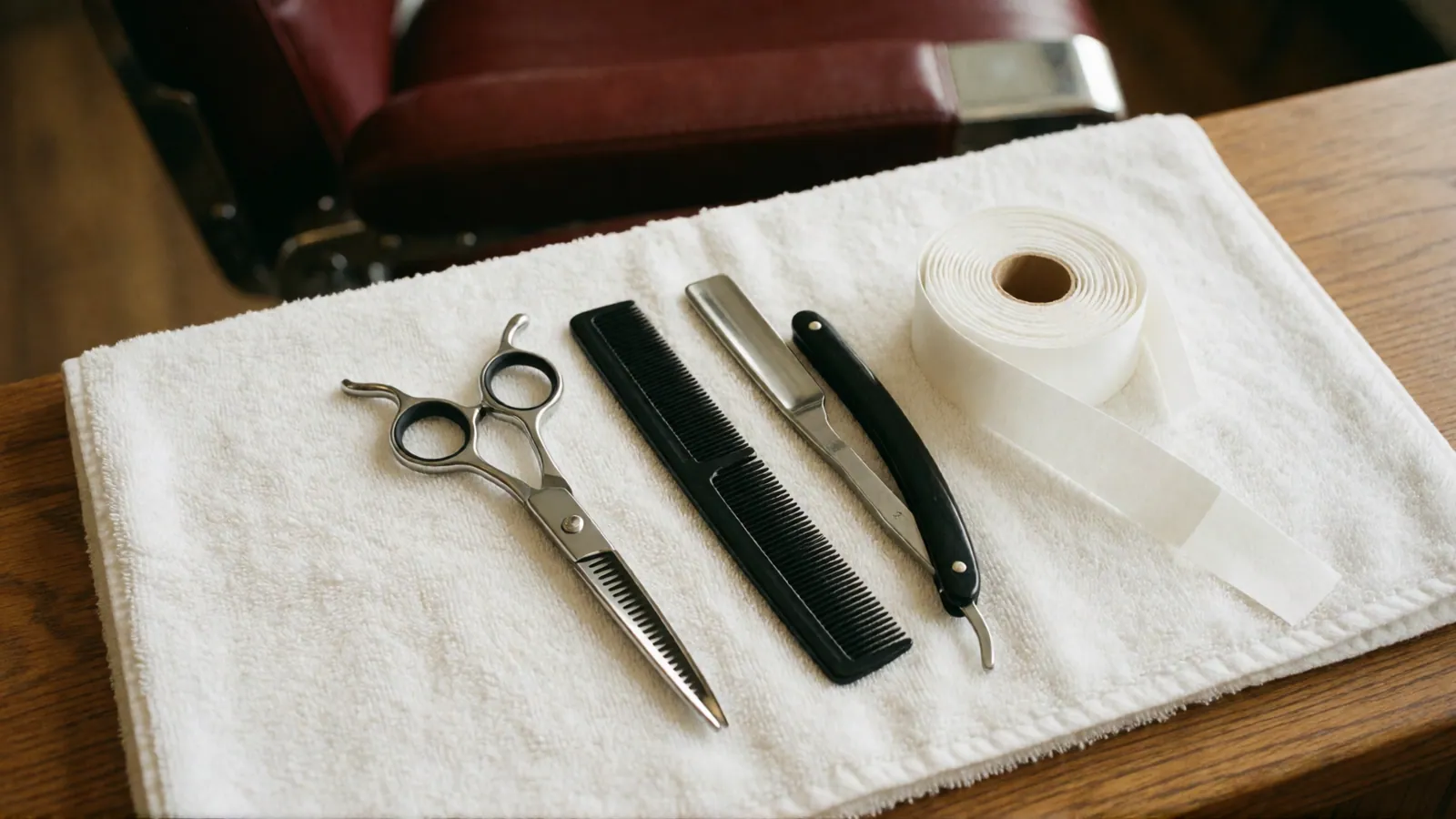
The header of this page
Round one had a shaving brush, which the shop does not use; both round-two takes looked through a street window; round three is shot from above, with no wall in the frame.
The header of the Prices page
Round one laid a shaving brush and a bowl of lather in the row; the shop uses no brush and lathers by hand.
The header of The shop page
Round one (with the room sentence) carried an EXIT sign, framed pictures and labeled bottles.
The header of the Hours and getting here page
Round one (with the room sentence) carried an EXIT sign and labeled bottles.
The header of the Walk-ins page
Round one (with the room sentence) carried an EXIT sign and labeled bottles.
The header of the Long hair and scissor cuts page
Round one looked through a window onto street signage.
The header of the Hot towel shaves page
Round one left part of the face uncovered and put a shaving brush and bowl on the tray, which the shop does not use.
The header of the Tapers page
Round one had the barber brushing the neck with a soft duster, which the City's rules do not allow.
A detail photograph on the Head shaves page
Both round-one takes stamped pseudo-lettering on the tang; round two frames the blade alone.
Ruel's station photograph
Round one set a shaving bowl and brush and a strop on the counter, none of which the shop uses.
Arif's station photograph
Round one laid a neck duster on the towel, which the City's rules do not allow.
Book a chair, or just walk in
Book a time with the barber you want, or with whoever is free first — or just walk in. The online calendar always keeps a chair back for walk-ins, and nothing is paid online.