Journal
A child's first haircut at a barbershop
The booster seat, the sound of the clipper, and when to stop. How a first haircut goes when nobody is in a hurry.
A child's first haircut here is short, unhurried, and stops the moment the child has had enough — today or next time, whichever it turns out to be. Nothing about it is rushed to fit a schedule, and nothing about it happens to a child who has not agreed to it first.
The rule in one line
The short version. The kids' cut is for anyone twelve and under — any short cut, $35. A parent or guardian stays in the shop, and nobody under thirteen gets straight-razor work.
Any short cut, the same as anyone else's
Any short cut — a classic cut, a taper, a skin fade or a buzz — for anyone twelve and under. It is not a separate, simplified service: the same classic cut, taper, skin fade or buzz that anyone else books, cut the same way, at a lower price for a child rather than a different one.
What is different is the pace, not the technique. A barber who does a lot of first haircuts reads a child's patience the way any barber reads hair — checking it constantly, and stopping the moment it changes rather than working straight through to a plan made in advance.
The booster seat, and the sound of the clipper first
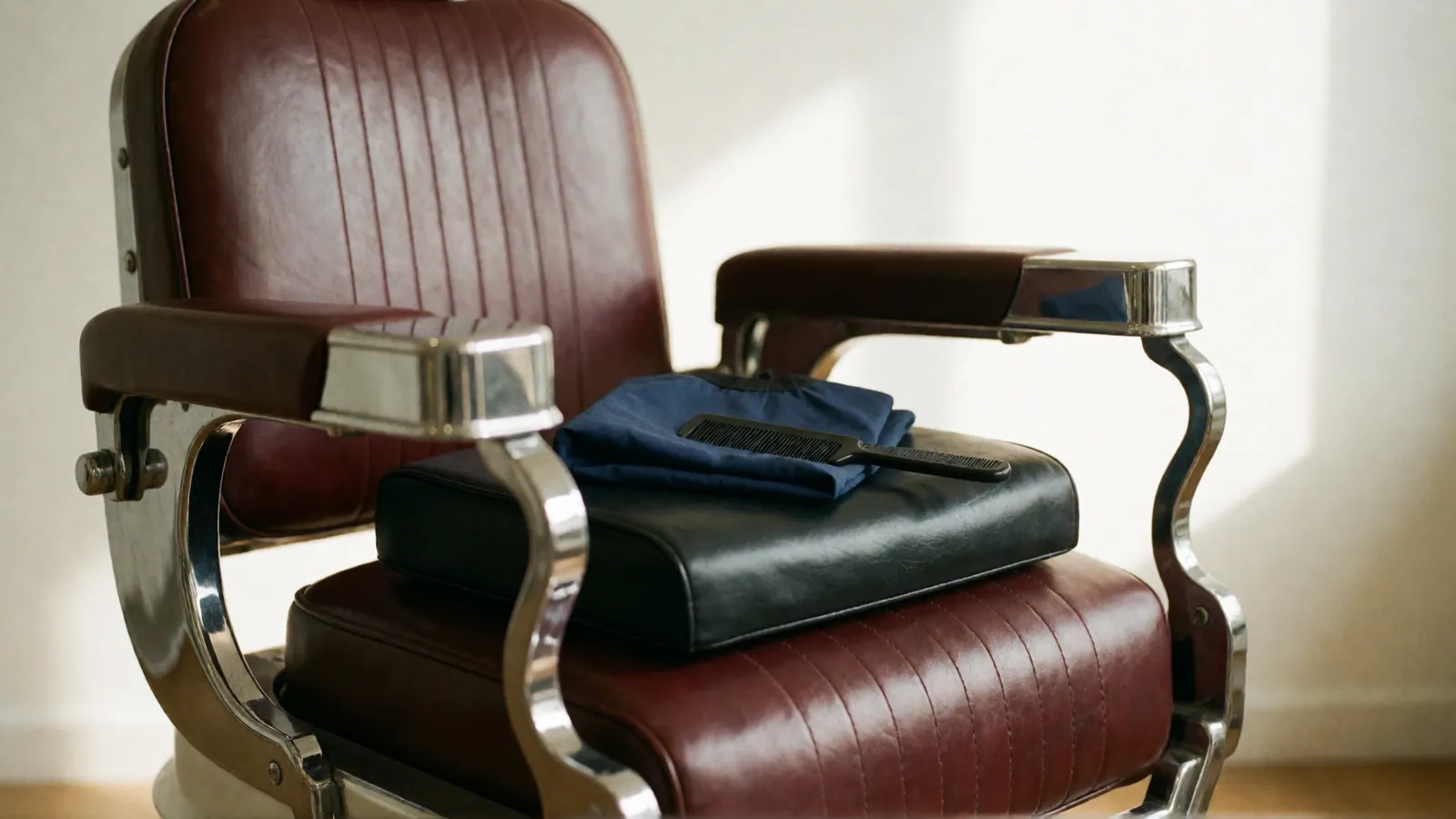
Tenzin cuts in chair four, which is the one with the booster seat. He does many of the kids' cuts and most of the first haircuts, and he keeps the clipper off until a child has heard it and decided it is fine.
A booster seat does two ordinary things: it gets a small child up to a height where the barber is not working at an awkward angle, and it puts the mirror in front of a child's own face rather than somewhere over their head. Hearing the clipper before it touches anywhere is usually the difference between a calm first cut and one that is not. Nothing about a first visit depends on a child sitting still through a sound nobody warned them about.
A parent stays in the shop
A parent or guardian stays in the shop, and a child under thirteen gets no straight-razor work — the neck is finished with a trimmer.
That covers the whole visit, not only the cut itself — from the moment the booster seat goes up to the moment the cape comes off, whoever brought the child is in the shop for it, not waiting outside or running an errand until it is done.
What helps beforehand
Telling a child in plain, calm words what is about to happen usually helps more than surprising them with it: there will be a seat that goes up and down, a cape, a buzzing sound, and a mirror at the end. Saying it will not hurt at all, unprompted, sometimes plants the very worry it is meant to head off — a matter-of-fact description does the job better than a reassurance nobody asked for.
Bringing a picture or naming a style in plain words works exactly the same way here as it does for an adult: it settles in seconds what a description alone can leave open to guessing, and it gives a nervous first-timer something concrete to look at instead of a stranger with clippers.
When to stop
She takes a good share of the kids' cuts, and she has a rule about them: the cut stops when the child has had enough, and the parent decides whether it finishes today or next time.
That is not a special exception made for a nervous child; it is simply how a kids' cut works here, every time, for every child.
The mirror at the end
A hand mirror, so you can see the back before you get up. This is the moment to say if anything is not right.
That last look happens for a child's first haircut exactly as it does for anyone's: a chance to see the back before getting out of the chair, and to say something if it is not right, rather than finding out later.
Which barbers do kids' cuts
Rosa and Tenzin take most of the kids' cuts here. Chair two. Skin fades and tapers, curly and coily hair of every kind, and the Saturday-morning kids' cuts.
Chair four, with the booster seat. Kids' cuts, first haircuts, fades, and scissor work when the top is long.
If a shared language makes it easier
Rosa speaks English and Spanish, and Tenzin speaks English, Nepali and Tibetan. If it is easier for a child to hear instructions, or for a parent to ask questions, in one of those languages rather than in English, say so when you book — there is no reason a first haircut has to happen in whichever language is simply first to hand.
Adding a hard part or a simple design
A kids' cut takes the same add-on a classic cut or a buzz cut does, for anyone who wants one: a hard part or a simple line cut in with a trimmer, done on the same visit.
A kids' cut with a hard part
- Kids' cut, 12 and underthirty minutes$35
- + Hard part or simple designfifteen minutes$10
- In the chair, and at the counterforty-five minutes$45
Kids' cut, 12 and under (thirty minutes, $35) and hard part or simple design (fifteen minutes, $10): the calendar holds forty-five minutes and the price at the counter is $45, before the City's 4.5% sales tax.
What it costs, and how long it takes
The kids' cut is booked for thirty minutes start to finish — long enough that nobody has to hurry a first visit, and short enough that it rarely needs all of it.
$35 thirty minutes
- Kids' cut, 12 and under, with Rosa and Tenzin.
- The kids' cut is for anyone twelve and under — any short cut, $35. A parent or guardian stays in the shop, and nobody under thirteen gets straight-razor work.
- Most people are back every three to five weeks.
- Paid at the shop, in cash or by card, not on this website. The City's sales tax is added at the counter.
Where to go next
- Kids' haircuts — the full page, whenever the next one is due.
Book a chair, or just walk in
Book a time with the barber you want, or with whoever is free first — or just walk in. The online calendar always keeps a chair back for walk-ins, and nothing is paid online.